Showing posts with label astronomy. Show all posts
Showing posts with label astronomy. Show all posts
Wednesday, December 16, 2015
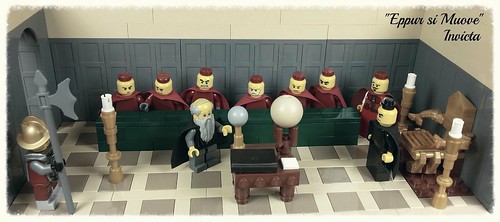
Eppur si muove
The conflict between Galileo and the Catholic church has been a constant topic in discussions of the relationship between science and faith. One extreme characterization is that scientists held that the earth orbited the sun, but the church denied this based solely on interpretations of the Bible. At the other end, some would say that there was a long dispute among scientists/philosophers about the best model of the universe, and in his defense of a heliocentric system Galileo went out of his way to antagonize and ridicule the pope, who held the opposite view. The truth probably lies somewhere in the middle, but in 1633 Galileo was called before the Inquisition to defend his views. Popular legend holds that after renouncing the Copernican model that the earth goes around the sun, Galileo muttered "eppur si muove" (but it still moves) under his breath - here in LEGO form by Jimmy Clinch.

Monday, March 30, 2015
Earth and Moon
Adam Dodge built Earth and Moon, a small orrery showing the rotation of the earth and the orbit of the moon. You can see a video of it in action here.

Friday, December 19, 2014
Kepler
The Kepler is an orbiting observatory tasked with finding Earth-like planets near other stars. It was feared that the mission was a failure due to mechanical problems, but recently a work-around was implemented so the it could be used, and this week NASA announced the discovery of a planet 2.5 times the size of earth about 180 light years away. Mr Grey designed this LEGO version of the Kepler.

Wednesday, June 4, 2014
Research Institute!
The result are in for the next LEGO Ideas set. LEGO Ideas is the successor to LEGO Cuusoo, a website where fan builders can submit their ideas, and if they get enough votes, LEGO will consider making an official set. This has been good for LEGO science fans, with three of the six sets released so far being science themed: the Shinkai research submarine, the Hayabusa probe, and the Mars rover. The recent round of review brought still another science set - the Female Minifigure Set. The original idea was to create a series of vignettes showing women in different occupations (I previously blogged about this). The idea was narrowed down to the chemist, the astronomer, and the paleontologist. This got a huge push because of the gender politics of the issue; as I've previously ranted, that's not the cool thing about this set, though that is surely what will make the headlines. What is cool about this set is that it shows scientists at work. The ultimate set, which will be a variation of the original idea shown below, will be called Research Institute and will come out this fall.

Friday, November 22, 2013
Hubble Telescope
A couple of days ago was the anniversary of Edwin Hubble's birth. Hubble was an extremely important astronomer in the first half of the last century, discovering distant galaxies and showing that the universe is expanding. Most people today know his name because of the orbiting Hubble Telescope (here built by GRusso) named in his honor.

Wednesday, August 7, 2013
Jill Tarter & Jocelyn Bell Burnell
I've previously blogged cookies of LEGO Rosalind Franklin and Hedy Lamarr made by Wendy Staples of the Quirky Cookie for a ScienceGrrl event. I really need to feature her versions of Jill Tarter & Jocelyn Bell Burnell as well.
Tarter is an American radio astronomer, who has spent much of her career on the search for extra terrestrial intelligence (SETI), and she did other important work on astronomical bodies such as brown dwarfs. Carl Sagan based the character Ellie Arroway in his novel Contact in part on Tarter. BTW, you should really read that book. The book (NOT the movie) is full of great insights into life as a graduate student, the conduct of international science, thoughts about how information can be transmitted, descriptions of radio telescopes, and even a very thoughtful examination of the interaction of science and faith.
Bell Burnell is another important radio astronomer, from Northern Ireland. She has had a long career in science and academics, but is perhaps best known for her discovery of pulsars as a graduate student. There was a bit of a controversy in that her research adviser, Antony Hewish, was awarded half of the 1974 Nobel, and not Bell Burnell. The question of who gets the true credit for a discovery - student or teacher - has always been a question. For the record, Bell Burnell has said publicly that she did not have problems with the decision as it was in keeping with common practice, and she has received a lot of recognition and awards for her work.

Just for good measure, Wendy also made a bunch of generic scientists as well.

Tarter is an American radio astronomer, who has spent much of her career on the search for extra terrestrial intelligence (SETI), and she did other important work on astronomical bodies such as brown dwarfs. Carl Sagan based the character Ellie Arroway in his novel Contact in part on Tarter. BTW, you should really read that book. The book (NOT the movie) is full of great insights into life as a graduate student, the conduct of international science, thoughts about how information can be transmitted, descriptions of radio telescopes, and even a very thoughtful examination of the interaction of science and faith.
Bell Burnell is another important radio astronomer, from Northern Ireland. She has had a long career in science and academics, but is perhaps best known for her discovery of pulsars as a graduate student. There was a bit of a controversy in that her research adviser, Antony Hewish, was awarded half of the 1974 Nobel, and not Bell Burnell. The question of who gets the true credit for a discovery - student or teacher - has always been a question. For the record, Bell Burnell has said publicly that she did not have problems with the decision as it was in keeping with common practice, and she has received a lot of recognition and awards for her work.
Just for good measure, Wendy also made a bunch of generic scientists as well.
Monday, July 22, 2013

Friday, June 7, 2013
Female figs Cuusoo project
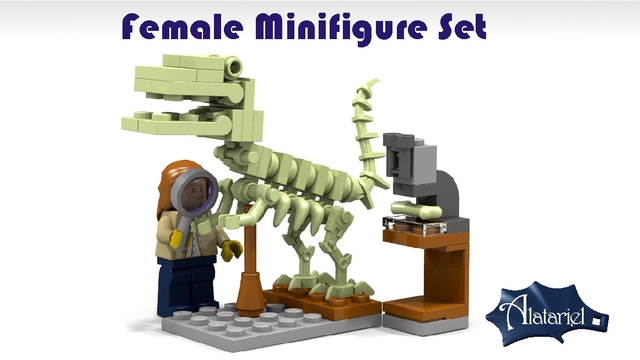
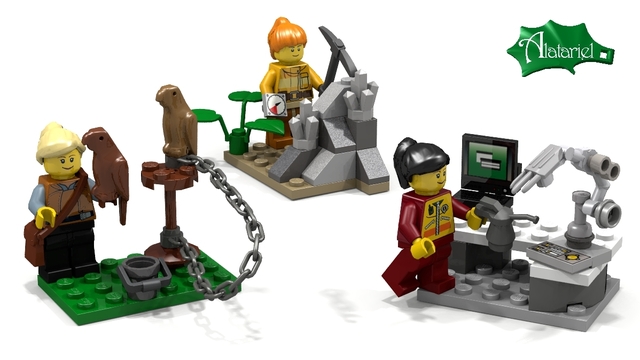
Cuusoo is a LEGO website for crowdsourcing set ideas. You propose a set, and if it gets 10,000 votes, LEGO promises to take a serious look at producing the set. Most of the sets that have made it to 10,000 have been attached to some movie/TV show/video game, and fans of that movie/show/game help push it over the top. That said, there have been two science driven sets already produced, the Shinkai submarine and the Hayabusa space probe, in the original Japan-only version of Cuusoo, and the Mars Curiosity Rover is being considered in the most recent round of creations that have reached 10,000. Now it seems that socio-political forces are pushing another to the top. Alatarial designed Female Minifigs to help correct the gender imbalance in Legoland, putting women in small scenes depicting different occupations. The cool thing, and the reason why I'm posting this here on SciBricks, is that many of those occupations are as scientists, probably because Alatarial is herself a geochemist: paleontologist, astronaut, astronomer, chemist, (falconer), geologist, and engineer (plus six others in non-science roles not shown here). I assume that this was recently posted on some social media site, or featured in some news source, because the project jumped from 2500 votes to 7500 in just three days.

Friday, May 31, 2013
Solar System
Last in my little mini-series on the images from my new banner is Nathan Sawaya's sculpture of the solar system. Nathan notes that he tried to put them in roughly relative scales, but he also notes that he's an artist, not a scientist. For a great side-by-side comparison tool, go to this link, that lets you compare the various planets to each other. Nathan also insists on including Pluto atop his sculpture. Seven years ago there was a debate in the International Astronomical Union about the status of Pluto. It turns out there are at least four other similarly-sized rocks out there (and Eris is bigger than Pluto). Rather than have a constantly expanding solar system as further celestial bodies are discovered, the IAU came up with classifications of 'planet' (Mercury, Venus, Earth, Mars, Jupiter, Saturn, Uranus, Neptune), and 'dwarf planet' (Pluto and friends). Due to tradition, and quite possibly due to the connection with the Disney cartoon dog, many have resisted the reclassification of Pluto (for instance, it was a subplot of an episode of the sitcom Sports Night).

Tuesday, February 19, 2013
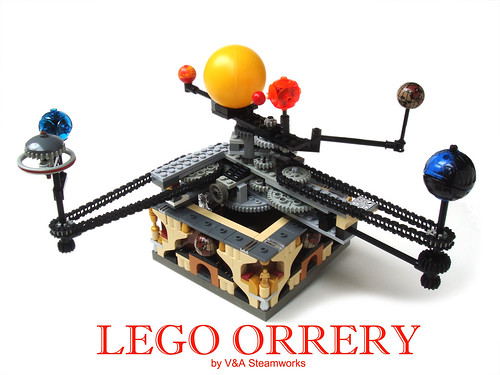
De revolutionibus orbium coelestium
As you know if you've been to Google, today is the 540th anniversary of the birth of Nocolaus Copernicus. He was the Polish astronomer most responsible for the heliocentric view of the universe. That is, the idea that the earth and the planets orbit the sun rather than the sun and the planets orbiting the earth. This motion is demonstrated by an orrery, a mechanical model of the solar system that shows the relative motions of the celestial bodies. V&A Steamworks made a great LEGO Orrery, and you can even see it in action.
Monday, August 20, 2012
Parkes Observatory
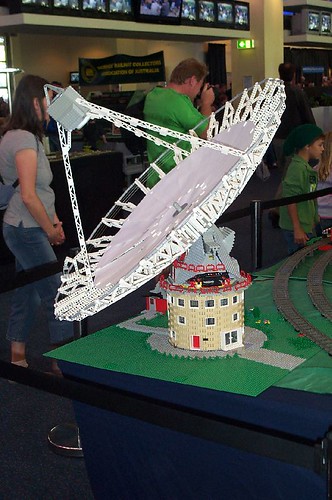
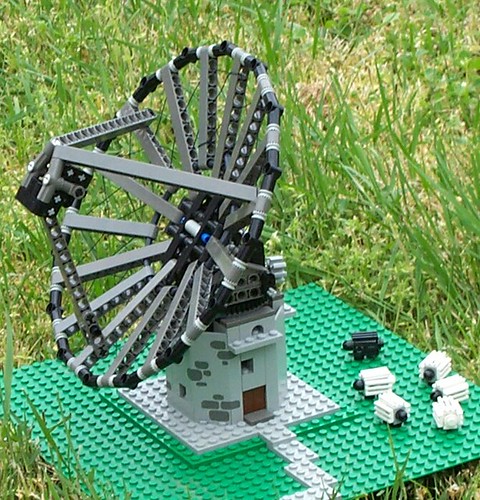
We are all familiar with optical telescopes that allow you to see magnified views of distant stars and planets. Visible light is only a small portion of the electromagnetic spectrum, though. Electromagnetic energy is a series of energies that travel as waves and they differ in their wavelength (which relates to energy). Visible light is just that section of wavelengths that our eyes can interpret. Radio is another portion of the electromagnetic spectrum with longer wavelengths (lower energies) than visible light. Stars produce energies across the electromagnetic spectrum, and to fully study them we should observe all of these different types of energy. So in addition to optical telescopes, we need other instruments. One example is the 64 meter radio telescope at the Parkes Observatory in Australia. Ross Crawford has built a couple of different LEGO versions.
Friday, March 23, 2012
Orrery
One more from Aklego, but this time in astronomy rather than math. He made this great orrery. As I've previously described, an orrery is a machine to show the relative motions of the planets and moons.
Monday, February 27, 2012

Friday, January 13, 2012
... in a galaxy not so far, far away ...
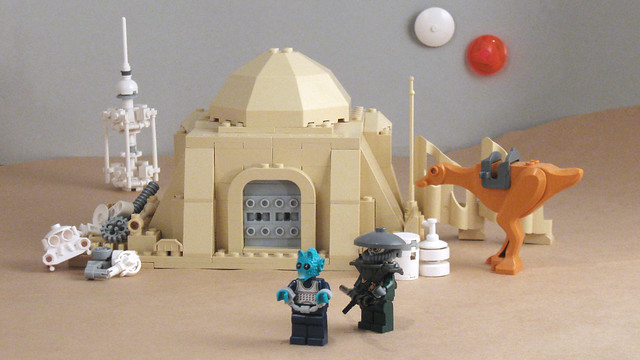
Astronomers using the Kepler space telescope have found a third real-lifeTatooine (here in LEGO by Larry Lars). No, they haven't seen Jawas running around. Instead they've found another planet circling a binary star. Though this was a gas giant, it was very near the habitable zone of the binary system. Scientists estimate there might be several million of these in the Milky Way, suggesting that there might be somewhere within a few hundred light years you could go out and watch the double sunset.
Monday, September 19, 2011
Sextant
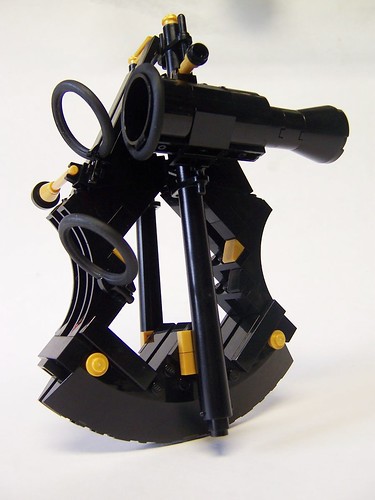
Matt Armstrong is doing a series of inventions and made this beautiful sextant. This instrument was first developed in 1757, and is used for measuring the angle between two distant objects - most importantly the horizon and a star. This can be used to calculate a ship's latitude, and was extremely important in helping ships navigate across oceans.
Sunday, July 31, 2011

Thursday, May 19, 2011
Haleakala Observatories
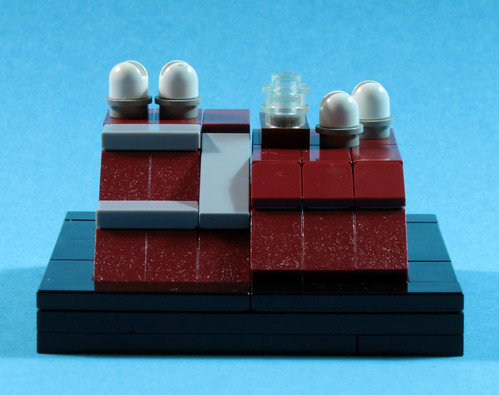
MorsLEGO made a tiny model of the Haleakala Observatories on Maui. The location (altitude, weather and lack of light pollution) makes this an ideal site. These observatories contain several telescopes and other instruments devoted to a wide variety of missions, such as tracking the movements of the earth's tectonic plates by bouncing a laser off the moon, tracking asteroids, a military project to track enemy satellites, and a telescope devoted to educational projects that teachers can apply to participate in.
Tuesday, May 3, 2011
Very Large Array
The Very Large Array is a multiple aperture radio telescope. That is, it is made up of 27 separate dishes that can be configured over a 22 mile radius to act as one huge radio telescope. Special carriers on railroad tracks allow the dishes to be arranged into different configurations. The VLA has been used to study such phenomena as ice on the surface of Mercury and cosmic jets of material expelled from distant galaxies. It's also showed up in popular culture, as in the final scenes of Contact. BTW, that's a really horrible movie, but the book is outstanding. If you read the book you learn about graduate school in the sciences, how research funding works, how radio antennae study distant galaxies, how we can encode and decode messages and international relations in the sciences. If you watch the movie you get to see Jodie Foster and Matthew McConaughey hook up.
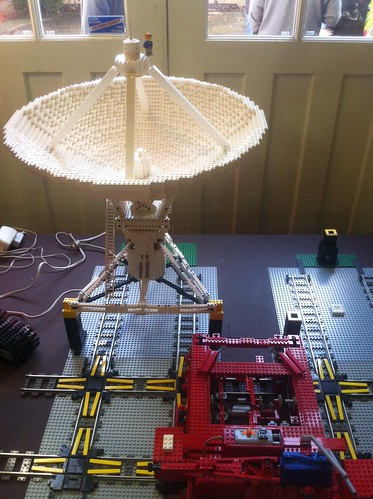
BTW, David Wegmuller even built a wprking mechanism to move his VLA dish, above. Now he just needs to build 26 more of these and spread them out over a gymnasium floor.
BTW, David Wegmuller even built a wprking mechanism to move his VLA dish, above. Now he just needs to build 26 more of these and spread them out over a gymnasium floor.
Monday, May 2, 2011
Arecibo Observatory
An optical telescope gathers the light coming from a distant object, such as a star or planet. Visible light, though, is only a small portion of the electromagnetic spectrum ranging from very low energy (long wavelength) to high energy (short wavelength). It's just the set of energies that happen to interact with our eyes. Stars and other astronomical objects produce energy over the whole range, and radio telescopes can gather information about these stars by looking at this energy. The Arecibo Observatory in Peurto Rico is the largest single aperture telescope around at 1000 feet in diameter, and it has led to such discoveries as the first binary pulsar, the first extrasolar planets, and prebiotic molecules in a distant galaxy. You may also recognize it from movies like Contact, where Jodie Foster first meets Matthew McConaughey. BTW, that movie ends at ... (hmm, guess you'll have to come back tomorrow) ...

Along with this, John Knight has done a number of other virtual LEGO models, including a highly detailed Space Shuttle, Vostok 1 and the Dominion Radio Astrophysical Observatory, among others. I hope he gets around to building these out of actual LEGO bricks. I know he has some, such as he used in his Hubble Telescope.
Along with this, John Knight has done a number of other virtual LEGO models, including a highly detailed Space Shuttle, Vostok 1 and the Dominion Radio Astrophysical Observatory, among others. I hope he gets around to building these out of actual LEGO bricks. I know he has some, such as he used in his Hubble Telescope.
Sunday, April 10, 2011
Crab Nebula
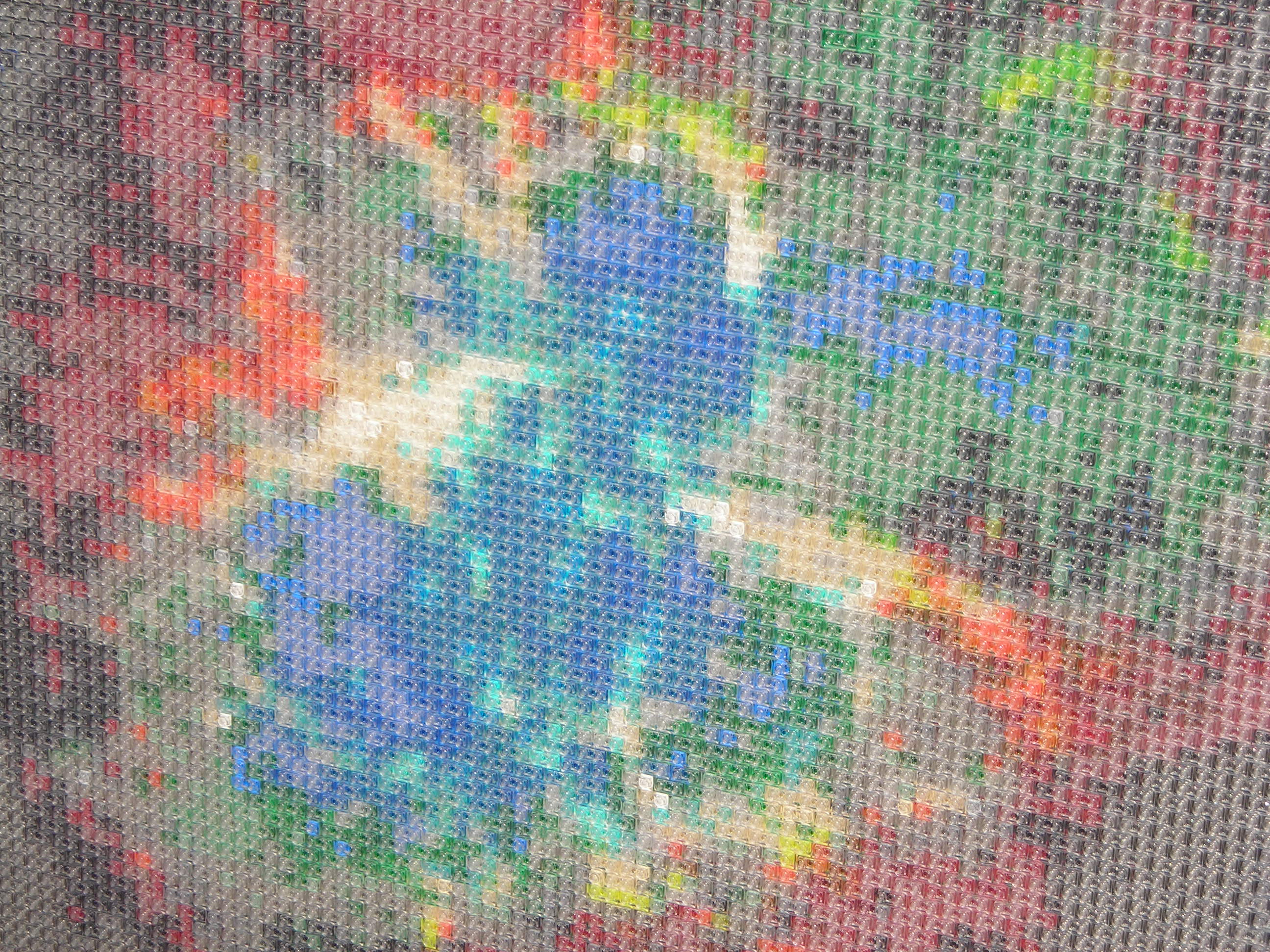
In 1054 AD Chinese and Arab astronomers noted a bright star in the sky. This was a supernova, the explosive death of a star. The cloud of gas left behind was first observed in 1731. It was eventually dubbed the Crab Nebula, because to some observers it was shaped like a crab. At the center lies the Crab Pulsar, a neutron star that is a strong source of radio waves and gamma rays. In addition to their astronomical significicance, these great clouds of gas and dust are often sources of interest due to their beauty, as seen in this mosaic by Arthur Gugick.
Subscribe to:
Posts (Atom)