Wednesday, June 13, 2012

Impossible objects

Several of the Escher illustrations depicted over the past few days are impossible objects - two dimensional drawings that seem to be of three dimensional objects, but turn out to be optical illusions, unbuild-able in real life. One of the first impossible objects, and one of the inspirations for Escher's Waterfall and other works, is known as the Penrose triangle. This was actually first depicted by Oscar Reutersvärd in 1934, before Roger Penrose independently presented his version.

The Penrose Triangle was the basis for the Lugnet logo. Lugnet was one of the first major LEGO websites.

John Langrish made this mosaic of the Lugnet Logo.

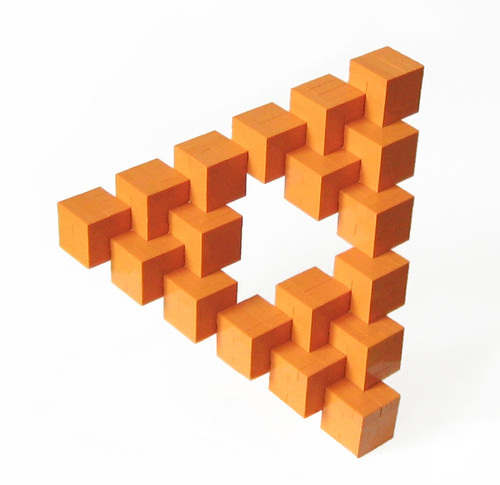
The Penrose Triangle has been recreated in LEGO many times. Some of these depend on Photoshop trickery, but others are true three-dimensional creaions, such as this by Billy Baldwin.

Brixe63's Modulex version is more remniscent of Reutersvärd's original design.
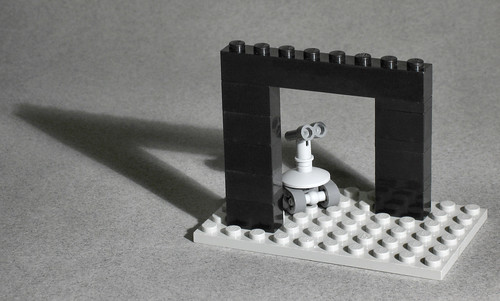
Various other LEGO impossible objects have been built, such as Don Solo's archway.
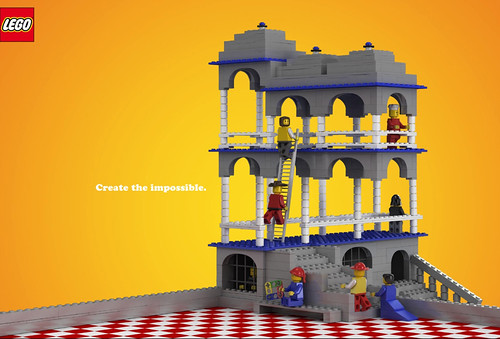
Brixe63 has had great fun with the idea in her set of optical illusions.
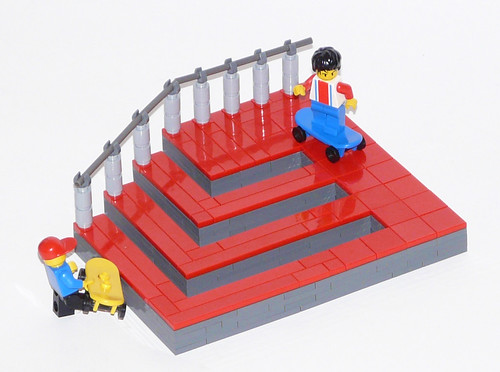
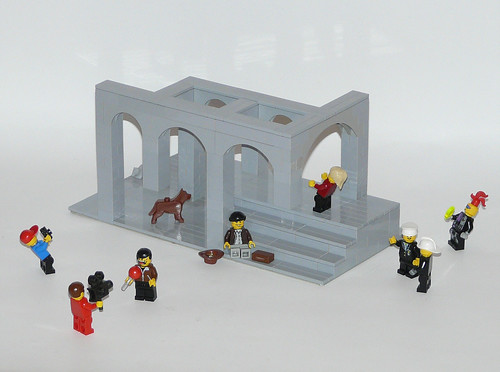
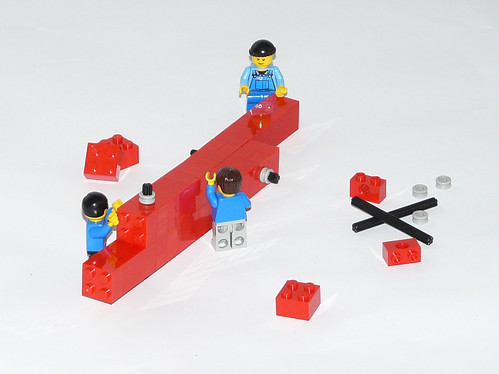
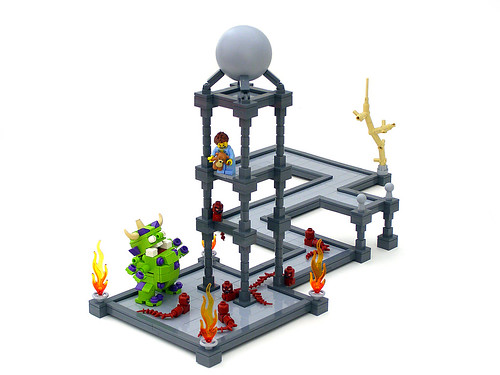
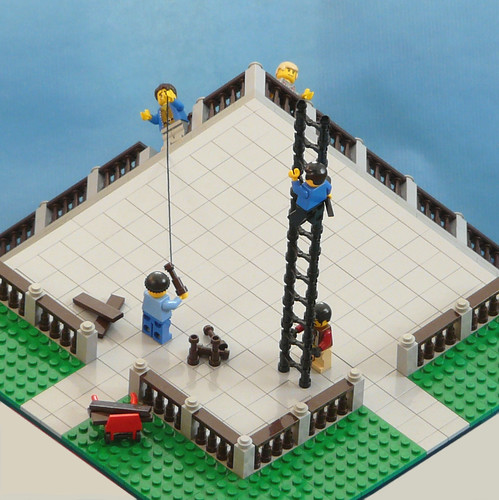
Brixe63 also has this amazing Terrace, that is based on an impossible scene that was apparently first used by Sandro del Prete (who was influenced by Escher).
Tuesday, June 12, 2012

More Escher roundup

Other Escher works have also been recreated in LEGO form, including ...

Day and Night by BrickWares.


Balcony by Andrew Lipson and Daniel Shiu


Drowned Cathedral by Minkowsky


Sky and Water I seen at Legoland


Reptiles by Profound Whatever


Double Planetoid at the Billund airport


Three Spheres II by Gwaehur


Rose by Aaron K


Drawing Hands by Ian Leino


... and by Littlehorn


... and by B.K.


... and by j p


Monday, June 11, 2012

Sunday, June 10, 2012

Escher: Belvedere

Belvedere has been another subject for LEGO Escher fans.

Andrew Lipson and Daniel Shiu.

Henry Lim.

Jung von Matt ad agency.

Brixe63, who has done a number of optical illusions, made some Belvedere-inspired bunk beds.

Saturday, June 9, 2012

Escher: Ascending and Descending

Continuing with our look at M.C. Escher in LEGO form, another very popular work is Ascending and Descending:

Probably the earliest version was by Andrew Lipson and Daniel Shiu.

Henry Lim's version.

The advertising agency Jung von Matt made a "create the impossible" ad.

Puriri deVry.

Buge Fun.

Raphael Heusser.

Friday, June 8, 2012

Escher: Relativity

M.C. Escher is surely the most popular artist among mathematicians and scientists. His explorations of symmetry and tricks of perspective and perception and his playful use of geometry all explore themes that are important across all of these fields. Several LEGO builders have taken on Escher themes. The first prominent effort was by Andrew Lipson and Daniel Shiu, who recreated five different Escher works in the early 2000's. In 2005, Henry Lim was commissioned by the Hong Kong Science Museum to make his own takes on four Escher pictures. Others have explored this work in LEGO form as well.

Perhaps the most popular Escher work in LEGO form is Relativity. Here is a version by Andrew Lipson and Daniel Shiu.

And another by Henry Lim.

Paul Vermeesh just recently posted a Star Wars version (which is what prompted this post).

Profound Whatever did a space version.

NewRight did a castle version.

Here's a version by Supernerd23

Big Daddy Nelson built this vignette

Thanks to Nannan of the Brothers-Brick for tracking down a couple of those links.

Thursday, June 7, 2012

Cyberknife

A CyberKnife is a robotic system to direct a carefully aimed beam of radiation to destroy a tumor. Radiation therapy works by hitting the cells with high energy sub-atomic particles. This radiation can damage cells by knocking electrons out of biomolecules. If electrons are removed from the DNA backbone, it causes the breakdown of DNA and the death of the cell. Dr. Rajesh Iyer, radiation oncologist with New Jersey CyberKnife and chairman of radiation oncology at Community Medical Center built this CyberKnife for his son.


Wednesday, June 6, 2012

Learning math

I've been using LEGO to help my kids learn math. Here my daughter is working on multiplication. She doesn't know it, though. She just knows that we're putting together stacks of two bricks, and counting the size of the resulting stack.


Then I taught her that we could write out the multiplication table we just built in bricks, where the 'x' stood for 'groups of', so 1 group of 2 is 2, 2 groups of 2 is 4, etc.


Tuesday, June 5, 2012

Hubble

The Hubble Space Telescope (on the right, by RomainGrosjean), has been in operation for the past 22 years. From its vantage point above the earth's atmosphere, it can take amazing high resolution images without the atmospheric distortion or light pollution that plague traditional observatories.


Monday, June 4, 2012

Spirit and Opportunity

The second rovers to land on Mars were Spirit and Opportunity as part of the Mars Exploration Rover Mission. Touchdown occurred in 2004 with a mission designed to last 90 Martian days. Contact with Spirit was finally lost in 2010 while Opportunity continues to operate today, over eight years later. You can learn more about the Mars Exploration Rovers at the official NASA/JPL Mars Exploration Rovers website. Minifig scale rover by apojove.


Thursday, May 31, 2012

Pathfinder

Apojove posted these pictures of his Mars Pathfinder, the unmanned probe that landed on Mars in 1997. He depicts it here as a tourist attraction in an imagined future. Interestingly, NASA recently released a request to future lunar explorers to please leave the Apollo landing sites alone to preserve them for future historians and to protect ongoing scientific studies.